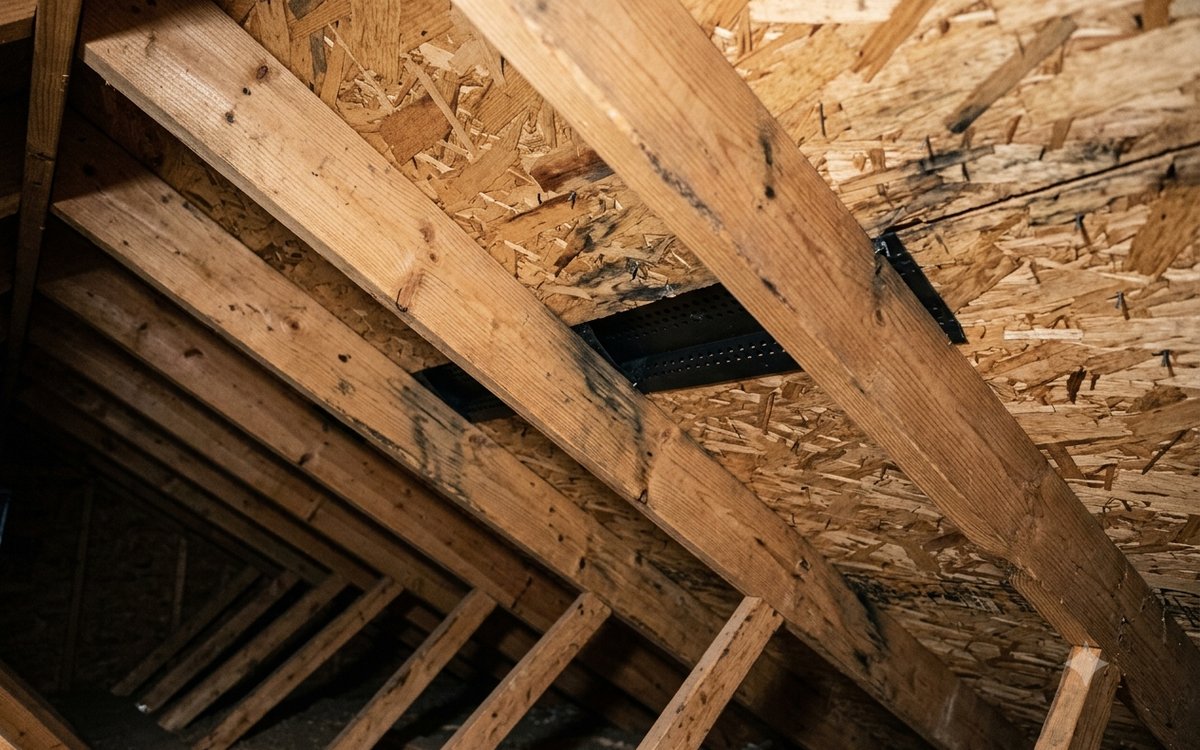
Attic growth is almost always a ventilation failure, not a roof leak. We diagnose which one you have before quoting removal.
An attic is designed to be ventilated, meaning outside air enters low at the soffits, moves up along the underside of the roof deck, and exits high at the ridge. That airflow carries away the moisture that rises out of your living space. When it stops working, warm humid air from inside the house hits cold sheathing in winter, condenses, and the roof deck stays damp long enough for growth to establish.
The pattern is diagnostic. Ventilation-driven growth appears diffuse across large areas of sheathing, generally worst on the north-facing slope and heaviest near the eaves where airflow is most often blocked. A roof leak, by contrast, leaves localized staining that traces back to a valley, a penetration, or damaged flashing. Those two problems need different repairs, and quoting removal before determining which one you have is guesswork.
Sheathing and framing are semi-porous, which means in most cases the growth can be removed rather than the wood replaced. We contain the access point so nothing migrates into the living space, HEPA vacuum and clean the affected surfaces, and treat the remaining material. Replacement is reserved for wood that is genuinely delaminated or structurally compromised, and we will show you the difference rather than asking you to take our word for it.
The remediation is only half the job. Correcting the airflow means clearing blocked soffits, adding baffles where insulation has crowded the intake, verifying ridge exhaust, and rerouting any exhaust fan that terminates in the attic. Without that, growth returns.
Attic growth turns up constantly during real estate inspections, and it frequently derails closings because nobody can tell the buyer whether it is cosmetic or structural. We provide documentation that separates the two: what was found, whether the wood is sound, what was corrected, and verification when it is complete. That is usually what gets a deal back on track.